Wood density variation in Serbian Spruce: A comparative study of natural stands and plantations
DOI:
https://doi.org/10.63356/gsf.2025.009Keywords:
Picea omorika, natural stands, plantations, physical properties of woodAbstract
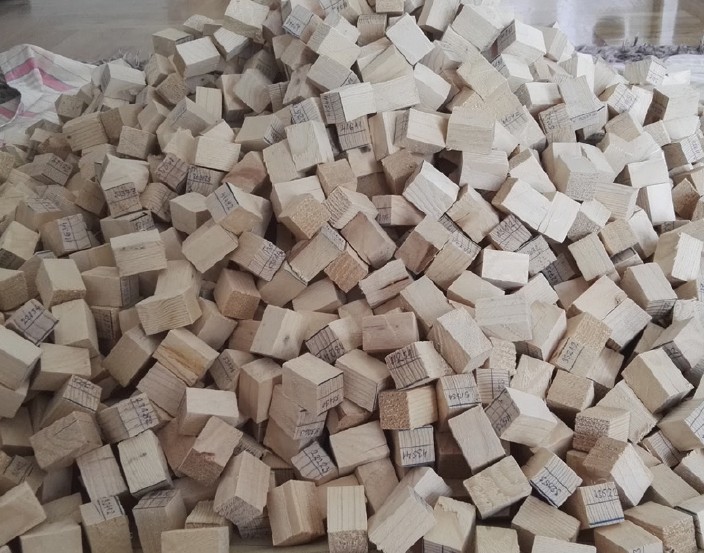
Serbian spruce (Picea omorika Pančić/Purkyně) is a Tertiary relict and an endemic species of the Balkan Peninsula, whose limited distribution range and pronounced ecological specificity make the study of its physical properties particularly important. The objective of this research was to determine the differences in wood density between Serbian spruce originating from plantations and from natural stands, as well as to analyze the variation of density in both axial and radial directions. The research was carried out at five locations in Bosnia and Herzegovina (Dubrava, Srebrenica, Gostilja, Stolac 1, and Stolac 2), using a total of 3,117 specimens. Wood density was determined in the oven-dry, air-dry, and green states, as well as by its nominal value. The average oven-dry wood density was 0.421 g/cm³ in plantations and 0.487 g/cm³ in natural stands. An increase in density with tree height was observed in natural stands, which contrasts with the typical trend in spruce and suggests an adaptive mechanism of the trees to static and dynamic loads. Radially, the density increased from pith to bark, consistent with the higher proportion of latewood. Significant correlations were established between wood density, ring width, and the proportion of latewood. The obtained results indicate that Serbian spruce can represent a sustainable alternative to Norway spruce in technical and industrial applications.
References
Aanerød, R. S. (2014). Modeling density and mechanical properties in Norway spruce (Picea abies (L.) Karst) by forest inventory data [Master’s thesis]. Norwegian University of Life Sciences, Department of Ecology and Natural Resource Management.
Dadswell, H. E., & Watson, A. J. (1962). Influence of the morphology of woodpulp fibres on paper properties. In F. Bolam (Ed.), The formation and structure of paper: Transactions of the II Fundamental Research Symposium, Oxford, 1961 (pp. 537–564). FRC. DOI: https://doi.org/10.15376/frc.1961.2.537
Donaldson, L. A., Evans, R., Cown, D. J., & Lausberg, M. J. F. (1995). Clonal variation of wood density variables in Pinus radiata. New Zealand Journal of Forestry Science, 25(2), 175–188.
Glass, S. V., & Zelinka, S. L. (2010). Moisture relations and physical properties of wood. In Wood handbook: Wood as an engineering material (Centennial ed., chap. 4, pp. 4.1–4.19). U.S. Department of Agriculture, Forest Service, Forest Products Laboratory.
Gryc, V., & Horáček, P. (2007). Variability in density of spruce (Picea abies [L.] Karst.) wood with the presence of reaction wood. Journal of Forest Science, 53(3), 129–137. https://doi.org/10.17221/2146-JFS DOI: https://doi.org/10.17221/2146-JFS
Harvald, C., & Olesen, P. O. (1987). The variation of the basic density within the juvenile wood of Sitka spruce (Picea sitchensis). Scandinavian Journal of Forest Research, 2(4), 525–537. https://doi.org/10.1080/02827588709382488 DOI: https://doi.org/10.1080/02827588709382488
Horáček, P., Fajstavr, M., & Stojanović, M. (2017). The variability of wood density and compression strength of Norway spruce (Picea abies /L./ Karst.) within the stem. Beskydy, 10(1–2), 17–26. https://doi.org/10.11118/beskyd201710010017 DOI: https://doi.org/10.11118/beskyd201710010017
Institut za standardizaciju Srbije. (2015). SRPS ISO 13061-2:2015: Fizička i mehanička svojstva drveta—Metode ispitivanja za male uzorke drveta bez grešaka—Deo 2: Određivanje zapreminske mase za fizička i mehanička ispitivanja.
Jenkins, B. M., Baxter, L. L., Miles, T. R., & Miles, T. R. (1998). Combustion properties of biomass. Fuel Processing Technology, 54(1–3), 17–46. https://doi.org/10.1016/S0378-3820(97)00059-3 DOI: https://doi.org/10.1016/S0378-3820(97)00059-3
Jyske, T., Mäkinen, H., & Saranpää, P. (2008). Wood density within Norway spruce stems. Silva Fennica, 42(3), 439–455. https://doi.org/10.14214/sf.248 DOI: https://doi.org/10.14214/sf.248
Karahasanović, A. (1962). Tehnička svojstva bosanske prašumske jelovine. Radovi Šumarskog fakulteta i Instituta za šumarstvo i drvnu industriju u Sarajevu, 7(7), 207–271. https://doi.org/10.54652/rsf.1962.v10.i7.423 DOI: https://doi.org/10.54652/rsf.1962.v10.i7.423
Kollmann, F. F. P. (1951). Technologie des Holzes und der Holzwerkstoffe (2nd ed., Vols. 1–2). Springer.
Kollmann, F. F. P., & Côté, W. A. (1968). Principles of wood science and technology: Part I. Solid wood. Springer. DOI: https://doi.org/10.1007/978-3-642-87928-9
Kommert, R. (1993). Die Holzeigenschaften der serbischen Fichte aus Anbauten im Freistaat Sachsen. Holz als Roh- und Werkstoff, 51, 329–334. https://doi.org/10.1007/BF02663804 DOI: https://doi.org/10.1007/BF02663804
Lukić-Simonović, N. (1955). O osnovnim fizičkim svojstvima i njihovom međusobnom odnosu kod Picea omorika Pančić. Glasnik Šumarskog fakulteta, 10, 237–266.
Lukić-Simonović, N. (1970). Uporedna istraživanja tehnoloških svojstava drveta Picea omorica Panč. i Picea excelsa Lin. u vezi sa uticajem staništa [Unpublished Doctoral dissertation]. University of Belgrade.
Mäkinen, H., Saranpää, P., & Linder, S. (2002). Wood-density variation of Norway spruce in relation to nutrient optimization and fibre dimensions. Canadian Journal of Forest Research, 32(2), 185–194. https://doi.org/10.1139/x01-186 DOI: https://doi.org/10.1139/x01-186
Mitchell, M. D., & Denne, M. P. (1997). Variation in density of Picea sitchensis in relation to within-tree trends in tracheid diameter and wall thickness. Forestry, 70(1), 47–60. https://doi.org/10.1093/forestry/70.1.47 DOI: https://doi.org/10.1093/forestry/70.1.47
Niklas, K. J. (1992). Plant biomechanics: An engineering approach to plant form and function. University of Chicago Press.
Panshin, A. J., & de Zeeuw, C. (1980). Textbook of wood technology (4th ed.). McGraw-Hill.
Shchekalev, R. V., Danilov, D. A., Zaytsev, D. A., Korchagov, S. A., & Melehov, V. I. (2023). Variation of physical and mechanical properties of Pinus sylvestris L. wood in the boreal zone of the European Northeast. South-east European Forestry, 14(2), 197–213. https://doi.org/10.15177/seefor.23-18 DOI: https://doi.org/10.15177/seefor.23-18
Siau, J. F. (1984). Transport processes in wood. Springer. DOI: https://doi.org/10.1007/978-3-642-69213-0
Šoškić, B., & Popović, Z. (2002). Svojstva drveta. University of Belgrade, Faculty of Forestry.
Todorović, N. (2006). Aksijalno utezanje drveta bukve (Fagus moesiaca Č.), hrasta kitnjaka (Quercus sessiliflora S.) i smrče (Picea excelsa L.) [Unpublished Master’s thesis]. University of Belgrade, Faculty of Forestry.
Ugrenović, A. (1950). Tehnologija drveta.
Wagenführ, R. (2000). Holzatlas (5th ed.). Fachbuchverlag Leipzig.
Ward, D. (1975). The influence of tree spacing upon tracheid length and density in Sitka spruce (Picea sitchensis (Bong.) Carr.) [Master’s thesis]. University College Dublin.
Zeidler, A., Borůvka, V., Brabec, P., Tomczak, K., Bedřich, J., Vacek, Z., Cukor, J., & Vacek, S. (2024). The possibility of using non-native spruces for Norway spruce wood replacement—A case study from the Czech Republic. Forests, 15(2), 255. https://doi.org/10.3390/f15020255 DOI: https://doi.org/10.3390/f15020255
Zobel, B. J., & van Buijtenen, J. P. (1989). Wood variation: Its causes and control. Springer. DOI: https://doi.org/10.1007/978-3-642-74069-5
Downloads
Published
Issue
Section
License
Copyright (c) 2025 Danijela Petrović, Vojislav Dukić, Dane Marčeta, Vladimir Petković, Srđan Bilić

This work is licensed under a Creative Commons Attribution 4.0 International License.