Report on some intriguing fungal species from sphagnum peatlands in Bosnia and Herzegovina
DOI:
https://doi.org/10.63356/gsf.2025.008Keywords:
mycobiota, wetlands, bryophilous fungi, endangered habitatAbstract
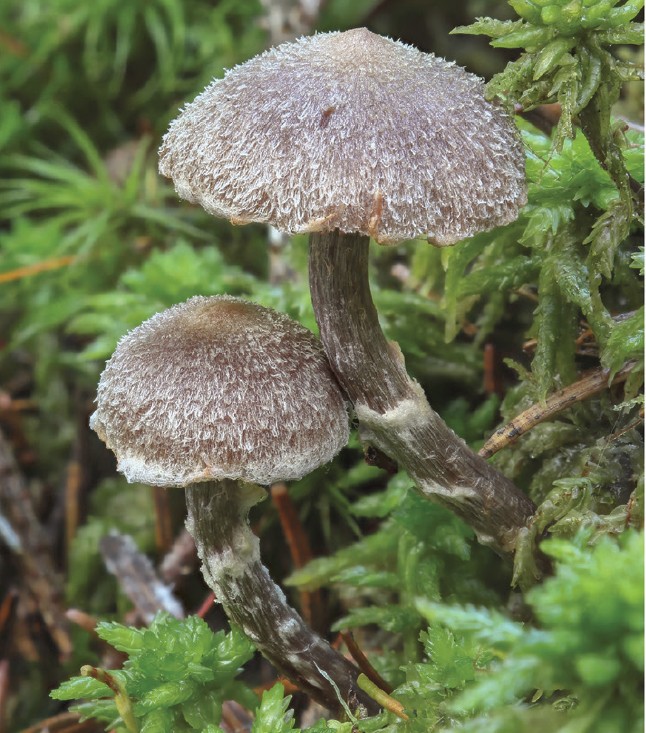
From October 2022 to October 2024, a series of mycological field studies were conducted in peatlands in Bosnia and Herzegovina, focusing on two bogs – Đilda’s bog and Bijambare bog. As a result, several interesting and characteristic fungal species were recorded. This paper presents Phaeonematoloma myosotis, Arrhenia leucotricha, Arrhenia philonotis, Cortinarius flexipes, Geoglossum sphagnophilum, Monilinia baccarum, Elliottinia kerneri, and Sarcoleotia cinnamomea.
References
Baral, H.-O. (1987). Lugol’s solution/IKI versus Melzer’s reagent: Hemiamyloidity, a universal feature of the ascus wall. Mycotaxon, 29, 399–450. DOI: https://doi.org/10.5962/p.418997
Baral, H.-O. (1992). Vital versus herbarium taxonomy: Morphological differences between living and dead cells of Ascomycetes, and their taxonomic implications. Mycotaxon, 44, 333–390. DOI: https://doi.org/10.5962/p.416290
Barudanović, S., Mašić, E., & Macanović, A. (2017). Raised bogs in the Bosnian mountains. University of Sarajevo, Faculty of Science.
Ćetković, I., Tkalčec, Z., Dragićević, S., Alegro, A., Šegota, V., Jadan, M., Matočec, N., Kušan, I., Zgrablić, Ž., & Mešić, A. (2020). Entoloma conferendum, Hygrocybe coccineocrenata, and Hypholoma ericaeum new to Montenegro. Mycotaxon, 135, 637–647. https://doi.org/10.5248/135.637 DOI: https://doi.org/10.5248/135.637
Eckstein, J. (2021). Trizodia acrobia, ein mit Cyanobakterien assoziierter Ascomycet auf Torfmoosen. Boletus, 42(1), 53–55.
Filippova, N. V. (2012). Discomycetes from plant, leaf and Sphagnum litter in an ombrotrophic bog (West Siberia). Environmental Dynamics and Global Climate Change, 3(1), 1–20. https://doi.org/10.17816/edgcc311-20 DOI: https://doi.org/10.17816/edgcc311-20
Filippova, N. V., & Bulyonkova, T. M. (2013). Notes on the ecology of Ascocoryne turficola (Ascomycota: Helotiales) in West Siberia. Environmental Dynamics and Global Climate Change, 4(2), 1–6. https://doi.org/10.17816/edgcc421-6 DOI: https://doi.org/10.17816/edgcc421-6
Filippova, N., Zvyagina, E., Rudykina, E., Dobrynina, A., & Bolshakov, S. (2023). The diversity of macromycetes in peatlands: Nine years of plot-based monitoring and barcoding in the raised bog “Mukhrino,” West Siberia. Biodiversity Data Journal, 11, e105111. https://doi.org/10.3897/BDJ.11.e105111 DOI: https://doi.org/10.3897/BDJ.11.e105111
Henriot, A., & Cheype, J.-L. (2025). Piximètre. http://www.piximetre.fr
Juan-Ovejero, R., Briones, M. J. I., & Öpik, M. (2020). Fungal diversity in peatlands and its contribution to carbon cycling. Applied Soil Ecology, 146, 103393. https://doi.org/10.1016/j.apsoil.2019.103393 DOI: https://doi.org/10.1016/j.apsoil.2019.103393
Jukić, N., Omerović, N., & Tomić, S. (2024). Diverzitet gljiva na tresetištima u Bosni i Hercegovini. Mycological Society MycoBH.
Krisai-Greilhuber, I., & Dämon, W. (2017). Die Pilze Österreichs: Verzeichnis und Rote Liste 2016. Teil: Makromyzeten. Österreichische Mykologische Gesellschaft.
Kušan, I. (2015). Contribution of “vital taxonomy” methods to the Ascomycota taxonomy (Doctoral dissertation). Josip Juraj Strossmayer University of Osijek.
Thormann, M. N. (2006). Diversity and function of fungi in peatlands: A carbon cycling perspective. Canadian Journal of Soil Science, 86, 281–293. https://doi.org/10.4141/S05-082 DOI: https://doi.org/10.4141/S05-082
Thormann, M. N., & Rice, A. V. (2007). Fungi from peatlands. Fungal Diversity, 24, 241–299.
Tkalčec, Z., Mešić, A., Matočec, N., & Kušan, I. (2008). Red book of Croatian fungi. Ministry of Culture; State Institute for Nature Protection.
Downloads
Published
Issue
Section
License
Copyright (c) 2025 Nedim Jukić, Nihad Omerović, Amar Hršumović, Jasmin Jukić, Smiljan Tomić, Faris Mušija

This work is licensed under a Creative Commons Attribution 4.0 International License.